Search Metzer Farms

Showing posts with label goslings. Show all posts

May 24, 2019

Geese as Adoptive Parents


Geese can make great adoptive parents for orphaned goslings or ducklings. While we have no scientific backup for this statement, customers and friends have had great success with introducing baby birds to their geese for adoption. There are a few elements that each of the stories have that might have contributed.

A customer of ours wrote us with her goose story. Her two female Pilgrim geese were trying to hatch eggs, but were having no luck. Wanting to give them something to care for, she found some ducklings at her local feed store and brought them home to her geese. The two took to the ducklings immediately. In this instance the mother geese were broody and their instincts were primed for taking care of babies.

Another person who wrote us had inherited a pair of geese with their property. They also brought in some ducklings. To their surprise, it was the male goose that took to them. He struggled to get to the ducklings until the family released them into the same pen. Once he was united with them, he started taking care of them as if they were his own. It is not uncommon for males to care for baby birds and are in fact programmed to help the mother in raising their offspring. In this case he was more excited than the female about the prospect of taking care of young ones and he took the initiative in the adoption.

Wild geese have been known to adopt as well. The Huffington Post once covered such an event. An expecting mother goose’s nest burned and she lost her eggs. A month later she adopted some abandoned goslings that someone had found in their pool. To read the full story, click here.

Of course, ducklings and goslings are not the only babies geese have been known to adopt. Another couple that wrote us talked about how their pair of Brown Chinese geese adopted an orphaned group of baby squirrels!

Geese will adopt older birds, too. They do not have to be day-old birds. An adoptive goose would probably take goslings up to four weeks of age!

It is highly unlikely that ducks will adopt, the only success stories we have heard were of geese doing the adopting.

If you do decide to introduce babies to your goose, we suggest going through an introductory process. The safest would be to have a fence between the babies and adults and see what happens. If the adult geese are good candidates, they will come to the fence and call to the ducklings or goslings on the other side. At that point you can put the one or two geese in with the babies and observe them. If there is no aggression by an adult, then you probably have a new family. If there is aggression, remove that goose and see if there are any others that have an interest in the babies.

Keep in mind that while these stories were all successful, not all attempts of encouraging an adoption are. It depends entirely on the goose involved. It helps to have them in the right frame of mind such as those that are already sitting on eggs, but it is not a definitive way to determine if a goose will adopt or not. Adoptions have occurred when the adults were not broody at all.

Adoptions can be very rewarding for you and your birds. The adults can raise those babies they always wanted, the babies are being raised by the best means available and you have much less work if your goose adopts the babies! Just pray your goose doesn’t adopt a baby skunk!

March 22, 2019

Sebastopol Geese


The oddest, yet one of the most popular of our geese breeds, is the Sebastopol. It is highly recognizable from their curled feathers. The definitive origins of the Sebastopol are unknown, but it is believed that they originated in southeastern Europe and that the name ‘Sebastopol’ came from the port town of the same name in Russia. Originally they were bred so their feathers could be used as stuffing in bedding but now they are strictly an ornamental breed.

The breed has been closely documented since its first showing in England in the 1860s. Jonathan M. Thompson on the Lifestock Conservancy has collected a variety of news article and journal entries that mention Sebastopol and its effect in the poultry world and social circles. 

Interestingly, the Sebastopol is known as Lockengans in German, L’Oie Frisee in French and in ancient Greek the word ‘sebastos’ means venerable, august, or magnificent. The Greek translation fits the Sebastopol perfectly due to its unique and striking feathers. Unlike other geese, the feathers of the Sebastopol’s body are soft and flexible, twisted and curled, and can grow to touch the ground. These special feathers cover the entire body except the neck and head. The plumage is pure white once they become an adult, but can have shades of gray as a juvenile.

Because of its curly feathers, the Sebastopol is not as winter or wind hardy as other geese. The curly feathers allow heat to escape far easier than the tightly packed feathers of other geese. Therefore, Sebastopols will require extra precautions and heating aids in windy and cold weather.

Other characteristics of the Sebastopol include orange feet and bill and the eyes are commonly blue. It grows to about 11 and 13.5 pounds.

Unfortunately, it lays about 13 to 18 eggs per year, has a fertility rate of about 45%, and typically has poor brooding skills. Doing the math, that makes an average of 7 fertile eggs per year per female, and that doesn’t begin to take into account hatch rates. This difficulty in production is but one reason why the Sebastopol is considered a threatened species and more expensive to produce.

Add their good looks to their rarity, and it is no wonder the Sebastopol is a popular goose.


Breed
Temperament
Weight
Egg Production
Mothering
Weeding Ability
Egg Size
Sebastopol
Nervous
11 - 13.5 pounds
13-18/year
Poor
Good
9.25 inches
Fertility
ALBC Status
APA Class
Conservation Status
Our Show Quality
Flying Ability
Origin
45%
Threatened
Medium
na
Good
None
Central Europe


March 08, 2019

Tufted Buff


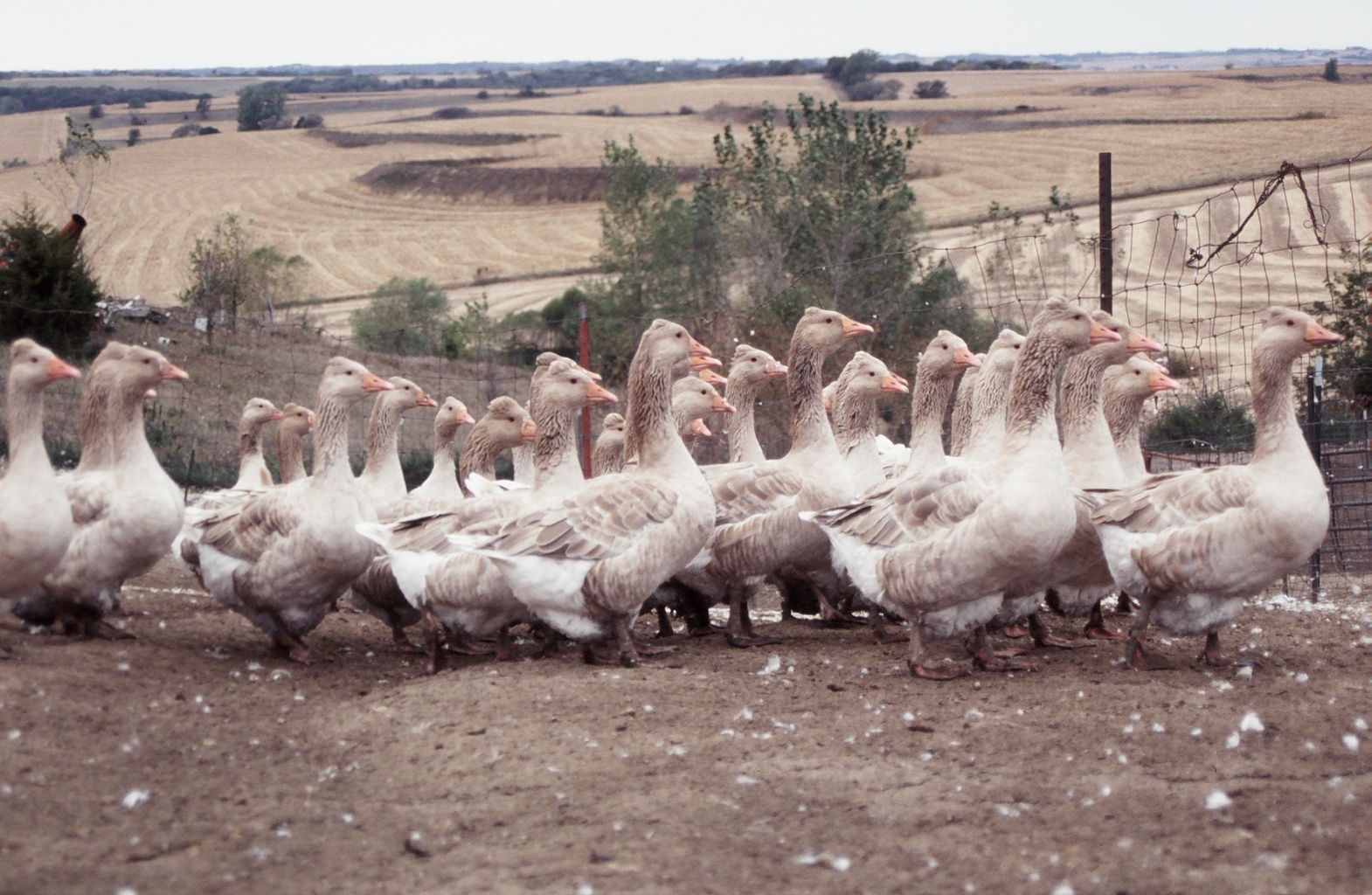
The Tufted Buff goose were created by crossing a Tufted Roman goose with a Buff goose. The initial goslings were white and tan and some with tufts. It took many years of crossing those with a lot of tan with those that have good tufts to get a Tufted Buff as we know it now. This hard work was done by Ruth Book of Book Farms in Granby, Missouri. The result is a Tufted Buff with a distinct helmet-like tuft of fluff on its head, but with the beautiful buff color of the American Buff.

Every now and again we do get a Tufted Buff that hatches with patches of yellow that turns white as it grows. We do not sell these as Tufted Buff, but instead include them in our Mixed Geese. This means if you purchase Mixed Geese, you might get an off-color Tufted Buff!

Since we purchased all of Mrs. Book’s breeders, we are one of the only commercial breeders of the Tufted Buff. They are not currently recognized by the American Poultry Association, but we hope that this will change as more people purchase them and begin to show them at exhibitions.

Several years ago, we sold some American Buff and Tufted Buff breeders to Andrea Heesters from the Netherlands. We encourage you to check out her website for pictures and more information.

The Tufted Buff can lay about 20-30 eggs a year and averages in size around 13-15 pounds full grown. The Tufted Buff is an easy-going bird in general and is a great addition to any flock. Or, if you just want one as a pet, they make for excellent companions.


Breed
Temperament
Weight
Egg Production
Mothering
Weeding Ability
Egg Size
Tufted Buff
Calm
13 - 15 pounds
20-30/year
Good
Good
9.25 inch diameter
Fertility
APA Class
Foraging Ability
ALBC Status
Our Show Quality
Flying Ability
Origin
75%
NA
NA
NA
NA
Low
USA


August 03, 2018

Bird Shippers of America and Salmonella


Shipping poultry across the US is a very big industry. All across the nation, people are ordering birds and picking them up at their local post office throughout the year. Thanks to the internet, the industry is growing daily and information is being constantly shared. Because of this, everyone with access to a computer or a phone is able to bring poultry on to their property as pets and farm animals, yet many are unaware of what raising poultry entails.

Other than the obvious care and management required to keep poultry, many, especially those looking to keep birds as pets, are unaware of the health risks associated with the task. That is where Bird Shippers ofAmerica (BSOA) comes in. BSOA is an online organization dedicated to the education and safe practice of raising fowl. It endeavors to be a vital source of information for all of your bird raising needs and “ - to improve the Backyard Poultry Industry”. This includes information of different breeds of birds, various tips and tricks in raising them, and making people aware of the dangers of Salmonella and how to protect you and your loved ones.

Salmonella causes 1.2 million illnesses, 23,000 hospitalizations, and 450 deaths every year within the US according to the Center for Disease Control (CDC). Most Salmonella infections come from food, but there are some strains of Salmonella that do not harm poultry but are carried by them and can infect people. It is because of these strains of Salmonella that those handling poultry must be careful.

To help educate our customers, we include a pamphlet from the CDC attached to the back of each invoice about the dos and don’ts when handling fowl.

Do:
  • Wash hands after handling live poultry
  • Adults should supervise hand washing for young children
  • Use sanitizer if soap is not available until you are able to wash your hands
Don’t:
  • Do not let those with weak immune systems, the elderly, or children under 5 handle live poultry
  • Do not keep live poultry in the house, bathroom, or any area where food or drink is prepared, served, or stored
  • No snuggling
  • No kissing

We invite you to read about Salmonella from the BSOA site and to continue to use its resources for any current and future poultry projects.

If you are involved with the mail-order poultry shipping industry, we also you encourage you to join the organization. Membership benefits includes the sharing of information within the poultry industry, access to updated information on research for the caring and shipping of day-old poultry, an avenue of information and response to any legislative changes that would adversely affect the industry, and a discount on postage for shipping your poultry.

Below is an infographic provided by the BSOA regarding precautions against Salmonella.


July 06, 2018

Hardware Disease


Ducks and geese are omnivores. If they think it looks interesting, they will try to eat it. This especially includes shiny things like coins, staples, nails, scrap metal, and the like. Obviously, this is not good for their health and can cause some severe problems. The issues caused by the ingestion of metals is collectively known as Hardware Disease.

While the objects themselves can cause damage, such as a sharp nail piercing the lining of the stomach, it is the poisoning from the metals as they breakdown that is the real problem. Symptoms include but are not limited to:
  • Loss of appetite
  • weight loss
  • weakness and lethargy
  • bright green or bloody droppings
  • difficulty walking
  • seizures
  • death
Poisons are typically fast-acting and once symptoms begin to show they should be treated quickly by a veterinarian. We have a list of veterinarians by state on our website that are knowledgeable in waterfowl care. If a veterinarian is not on hand or not feasible, there are some things you can do to help. Countryside Daily suggests feeding your ducks molasses or charcoal pills to flush out the toxins. Lisa Steel of Fresh Eggs Daily advocates more for prevention, though she does list several herbs such as bay leaves, dill, sage, and thyme mixed as a salad to help detoxify. For objects that would not pass naturally, such as a metal springs or larger pieces of glass, they will require surgery.

The best way to prevent hardware disease is to remove any potential objects your birds might eat. This means monitoring the pen or pasture for anything they might dig up or find. If there has been a building project, make sure all screws, nails, and staples are picked up. To be very thorough, a metal detector would be of help.

Example of things we've found laying around.

March 02, 2018

What Causes Runts?


The word ‘runt’ has a lot of negative connotation to it. Runts are thought of as weak and sickly. I’m here to tell you that this is not true! The official Google definition of a runt is “an animal that is smaller than average”. A runt is just a smaller version of the same breed. That doesn’t mean it is sick or weak, just small.

What causes this? Our veterinarian’s theory is that it has to do with the flora in the gut. Everyone has bacteria in their stomach, both good and bad. The good bacteria colonizes in the stomach and helps with digestion. Runts, however, do not seem to have as much good bacteria or it has the wrong kind of bacteria colonizing in its gut. This means that it doesn’t digest its food as well and therefore does not grow as fast as its siblings.

There is a way to fix this. By providing the correct probiotics, runts are capable of catching up in growth with the rest of the flock. You can find probiotic supplement packs at your local feed store or Amazon. The probiotics help to develop the good bacteria in the bird’s gut that will help with digestion and facilitate growth. You can mix this in the communal feed as the extra probiotics may benefit your other birds, too.

Other potential causes include hatching from small eggs, viral infection, genetics, coccidiosis, and bacterial infection during incubation. While these are valid causes, our veterinarian believes they cause far fewer runts than improper bacteria in the gut.

For further information, Andy Schneider, the Chicken Whisperer, has an article in his Chicken Whisperer Magazine that goes further into probiotics for poultry. While this article is about chickens, the same applies to ducks and geese.

The main question is what this means for you. If you are a commercial producer, we suggest culling the runts if only because their growth rate will be off of your expected processing date. For example, Pekin are ready for processing at 7 weeks, but your runt may not catch up until about week 12.

The following picture is from one of our customers, a Hutterite colony in Montana in 2014. They and other colonies order Pekin ducklings by the thousands and you can clearly see in the photo that there were several ducklings that were not growing as fast as the others. They were 4 weeks and 4 days of age for the picture. When it came time for processing at 12 weeks, however, they could not tell which had been the runts!

If your main concern is egg production, a runt’s egg production start will probably be delayed. If the runt is treated, however, and catches up in growth, they should be on time to start laying with the rest of the flock.

Both the meat and eggs are still good to eat. Remember, a runt is simply smaller.

Whether your birds are pets or not, make sure you keep them all fed, watered, and warm. It will take time for them to catch up in growth, but it will be worth it in the end.

February 02, 2018

Determining How To Supplement Your Duck’s Diet With Niacin


-John Metzer

There are four easy ways to supplement your bird or flock’s diet with niacin (vitamin B3) if you feel it is necessary: tablets, liquid, vitamin packet or Brewer’s Dried Yeast. We will explain how to supplement with each of these.

We are going to assume:

1) Your current feed has no niacin and therefore we we have supply 100% of their niacin needs. This is not accurate as all poultry feeds have some niacin but this way you know the maximum you should supply and we found no research that indicates a double or triple dose of niacin will harm your birds.

2) Your bird is eating about .35 pound of feed a day. This is typical of a Pekin at about three weeks of age when niacin deficiencies normally appear. Other breeds are probably eating .2-.3 pounds per day at the same age and an adult laying Pekin is eating about .45 pounds per day.

Niacin Tablet
If your duck is eating .35 pounds of feed per day and they need about 55 parts per million (ppm) of niacin a day, this means they need about 9 mg of niacin a day (.35 x 55 / 1,000,000 x 454 x 1000)).

Tablet
Most tablets contain 500 mg of niacin. So if you divide 500 by 9 you get 55. This means that one tablet can supply enough niacin for 55 doses. Those 55 does can be used for 55 ducks in one day or 55 days for one duck. Or you can simply mix it into feed. If one dose is for .35 pounds of feed, then one tablet is for 19 pounds of feed (.35 x 55). Just make sure you grind the tablet well and ensure it is mixed thoroughly in the feed.

Liquid
Liquid B3 Vitamins


In one liquid supplement product we found, there were 12 mg of niacin in 10 drops of liquid. This means that each drop has 1.2 mg of niacin (12 / 10). Therefore, the daily dosage is about 8 drops (9 / 1.2). The problem with adding niacin to the water is that ducks typically don’t drink all the water they use. How much do your ducks splash and waste? Of course if you use nipple waterers waste is minimal and you can assume they drink all the water they use. Then you can add liquid niacin to their water. As they drink about .17 gallons per day at this age, then you need to add 47 drops per gallon of drinking water (1 / .17 x 8). Of course you can always add eight drops to each duck’s feed each day. But don’t mix more than one day at a time as the increased moisture might lead to mold which is not good for waterfowl.


Poult Vitamin and Mineral Packet

Another alternative would be to use the PoultVitamin and Mineral Packet we sell. This packet has 7500 mg of niacin in it and is designed to be added to 128 gallons of water or 1/2 teaspoon will treat 3 gallons of water. If you treat using this method, your birds will be consuming about 10 mg of niacin a day (7500 / 128 x .178) in addition to supplemental levels of other vitamins and minerals.

Brewers Dried Yeast
There are two types of Brewers Dried Yeast – human grade and livestock grade. Human grade has 5 mg of niacin per 15 grams of yeast (one tablespoon). Livestock grade has 1.5 mg per 15 grams of yeast. So if your duck needs 9 mg per day, they need slightly less than two tablespoons of human grade (9 / 5) or 6 tablespoons of livestock grade yeast (9 / 1.5) per day. If you want to mix the yeast in 50 pounds of feed, you would need to add 285 tablespoons of human grade yeast (50 / .35 x 2) or 855 tablespoons (50 / .35 x 6) of livestock grade yeast. As there are 64 tablespoons in a quart, this amounts to 4.5 quarts of human grade or 13 quarts of livestock grade yeast added to each 50 pounds of feed. As this is a significant amount of feed you have added to a balanced ration, you have now thrown off the balance of all other nutrient levels. Hence it is probably best to add additional niacin with tablets, vitamin packets or liquid niacin.


Brewer's Yeast
As stated earlier, these formulations are for a bird that is not getting any niacin in its feed. This is not realistic so if you are wanting to merely supplement in case your feed is short in niacin, then you may want to add half the recommended amounts of supplemental niacin. In addition, niacin deficiency problems normally only occur when your birds are growing at their most rapids rates - from two to seven weeks of age. Therefore, supplementation is rarely needed past ten weeks of age.

January 19, 2018

Niacin: What is it and Why do my ducklings and goslings need it?


-by John Metzer

Niacin is also known as Vitamin B3and is vital for good health and growth in waterfowl. Compared to chickens, waterfowl need 2 to 3 times the amount of niacin in their diet during their initial growth period, hence the occasional problem with low niacin levels being fed to waterfowl. Once they are grown, a niacin deficiency is very rare. Most owners do not know that there is a niacin problem until signs of a niacin deficiency occurs.

How to Identify a Niacin Deficiency

A niacin deficiency can be seen in the legs of the bird. If the legs are bent or “bull legged”,are pigeon toed, splayed to the sides, or are unable to support the weight of the bird, there is a high likelihood that it is due to a niacin deficiency. Such legs make it very difficult for the birds to move, preventing them from getting adequate amounts of food and water.


Remember, ducklings do the majority of their growing in the first 10 weeks of life. About 90% of niacin problems occur during this time.

Causes of a Niacin Deficiency

Typically poultry feed has enough niacin in it. If it doesn’t that means a mistake was made in making the feed or the feed is not formulated with enough niacin for waterfowl. Unfortunately poultry feed manufacturers are not required to put niacin levels on the feed tag. If you have a concern that your feed is low in niacin, you can phone the feed manufacturer and ask them how much niacin is in the feed. The feed store will probably not know, you will need to contact the feed manufacturer directly.

How to Fix it

Chicken feed, while it can be used as a starter, sometimes needs to be supplemented by niacin in one form or another. Supplements include niacin tablets, Vitamin B3 drops, and brewer's yeast. These supplements can be found at your local feed and vitamin stores.


Determining how much to supplement with niacin tablets, vitamin B3 drops, and brewer’s yeast will be covered in a future post.


Recovery?

Customers have said that a limping problem has been fixed after supplementing with extra niacin. However, if you do not correct the problem immediately and the bones become deformed, the legs cannot be straightened once you start supplementing with extra niacin. Hence, you must supplement as soon as you are suspicious you have a niacin deficiency.

Side Note

We have been asked if it is possible to overdose on niacin. Because of how small the amount is, it is easy to think you can give your birds too much. The answer is that you would need a lot to overdose. We don't have an exact amount to point towards, but humans can overdose on niacin and that can cause bowel problems. If your birds start having digestive issues, then it's a possibility, but is unlikely.

November 03, 2017

Getting Ready for Your Ducklings and Goslings: Heating


Welcome back to our series of posts to help you get ready BEFORE your ducklings and goslings arrive!

To read our post on the brooder and bedding, go to Getting Ready for Your Ducklings and Goslings: Brooder and Bedding.

To read our post on water and waterers, go to Getting Ready for Your Ducklings and Goslings: Water and Waterer.

To read our post on feed and feeders, go to Getting Ready for Your Ducklings and Goslings: Feed and Feeder.
 

Heating and Heating Lamp

Ducklings and goslings are vulnerable after hatching and require a source of heat for a period of time. Originally, this was mama duck's job, but as there is no mama duck, you will have to find another source of heat.


Heat lamps are the easiest and most common way of heating your brooder. Here on the farm we use and offer heat lamps with 150 watt bulbs. The hood is aluminum and has a ceramic setting. If you want to find your own bulb, we recommend finding a clear white bulb. You can use a red bulb (infrared), but those are used primarily for chicks to prevent cannibalism which is rarely seen in ducklings.
Heating lamp in our brooder room
Heat lamps can be hung using chains from the ceiling or clamped onto a wall of the brooder. Temperature is controlled by lowering and raising the lamp. In the picture above, we have cut out notches in an aluminum flat bar and attached them to heat lamps to easily move them up and down.

We typically suggest starting at 90-95 degrees Fahrenheit under the heat lamp, but if you live in a warm area you may only need to turn on the lamp at night. It typically takes about a month or so for ducklings and goslings to start growing in their feathers. You can normally shut off supplemental heat within two to three weeks.

Make sure the heat source is off to the side so that they can leave the heat to cool off if they want. The important thing is to observe them. If they start huddling, you know they need more heat. If they stay away from the heat lamp, you can raise or remove it. If they start panting, then they are too warm and you can remove the heat lamp.

Brooder Thermometer

In order to know the temperature of your brooder, we suggest using a thermometer like the one we offer.

Warning!

Heat lamps can be a fire hazard if improperly handled.

Alternatives
If you decide a heat lamp is not for you, you can try a BrinseaEcoGlow Brooder. They make two sizes and Brinsea claims they are safer as they use 12 volt power for heating.


Hot water bottle and knit cover.
For those with no electricity, hot water bottles covered by towels are an effective alternative. Just be sure to switch out the water as the bottles cool, especially during the night.

We encourage you to get creative. There are many different ways of setting up your heat source.

What setup do you use?