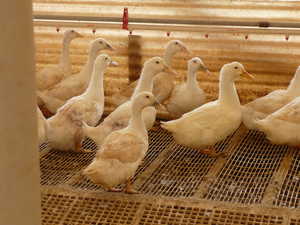
In last week's blog, we talked about how long the day length should be to maximize duck egg production. Now I want to go over the types of lights to use, the use of time clocks and how geese are completely different than other poultry in terms of light stimulation.
The choice of bulb depends on how many birds you have to light. If you have a small flock, a single 100 watt incandescent bulb is sufficient. Fluorescent bulbs are more efficient than incandescent. The most efficient, which most commercial poultry operations use, are high pressure sodium lights. This is what we use. They are often used as street lights and give off an orange colored light.

A high pressure sodium light in our duck breeder building.
Birds are stimulated reproductively by the orange/red spectrum in light. Incandescent and sodium lights have plenty of these colors. If you have a choice with your fluorescent bulbs, try to get the more natural colored tubes and not the cool white tubes which have more of the blues and greens in them.
There are two basic time clocks. Industrial time clocks are wired into your electrical system and can control a complete circuit containing many lights. The home type of time clock is one that plugs into an outlet and is normally used in a home to turn a light on and off. One of the advantages of the industrial type is you can make as small an adjustment as you want when you want to change on and off times. You just loosen the screw, move it slightly and re-tighten it. They are also heavy duty for a long life and can handle quite a few lights.

Industrial type time clock.
The main advantage of the home type is they are easy to find and use. A disadvantage of the home type is that it has plug-in on/off switches with a minimum adjustment of 15 minutes. Another disadvantage of the home type time clock is that they normally do not have a grounding plug or slot.

Home style time clock
Green - on
Red - off

Notice there is not a grounding plug in the back and there is not a hole for a grounding plug on the time clock itself.
Most people cannot see their birds' lights in the evening and morning. So how do you know the time clock is really working? We plug a home style time clock into the circuit of lights that are coming on and off each night. Nothing is plugged into this time clock – we just use it as a monitoring device. The dial on this time clock is set at 12:00. Every morning we check to see how long the time clock has run the previous night and then turn it back to 12:00. If your lights are supposed to be on for two hours in the evening and two hours in the morning, then the time clock should read 4:00 in the morning when you pick up eggs. If it doesn't, then something is not working correctly. Of course this will not tell you if a bulb has burned out - but only if your time clock is working correctly.

Monitoring time clock to make sure the controlling time clock is working properly - must be reset to 12:00 each morning.
It is probably better to have two smaller lights instead of just one big light in case one bulb burns out. The birds will not be as adversely affected with some light versus no light.
If your birds have access to an outside pen during the night, you should light that pen, too. You want them exposed to the light, no matter where they bed down at night. By the way, the light enters the brain directly, it does not go through their eyes – so the light stimulates them whether they are awake or asleep.
Geese are unique in how light stimulates them reproductively. No one photo-stimulates geese in North America to maximize egg production - as is typically done with other poultry. The reason is that excessive light (meaning 13+ hour lighted day lengths) depresses egg production in geese. For other poultry you maximize egg production with 16-17 hour days. You can only achieve maximum egg production in geese by providing a maximum of 10-11 hour days! Looking at the light charts from last week's blog, you can see that most of the time our days are longer than 11 hours – and this is too long for maximum egg production for geese. So to maintain egg production as long as possible in geese, you need light tight houses – which means no natural light enters the building. The only light is provided by lights so you can provide them only 10 or 11 hours of light a day - no matter the time of year. More on this later.
For those of you that enjoy our blogs, please sign up on the upper, left side of this page. Just type in your email address and hit “Subscribe”. You will then be sent an email and link every time a new blog is posted. It is easy to unsubscribe if you ever lose interest in our blogs. I wouldn't know why! But I suppose anything is possible! :)